Rummy FAQ: Can a Joker Rescue an Unclear Hand?
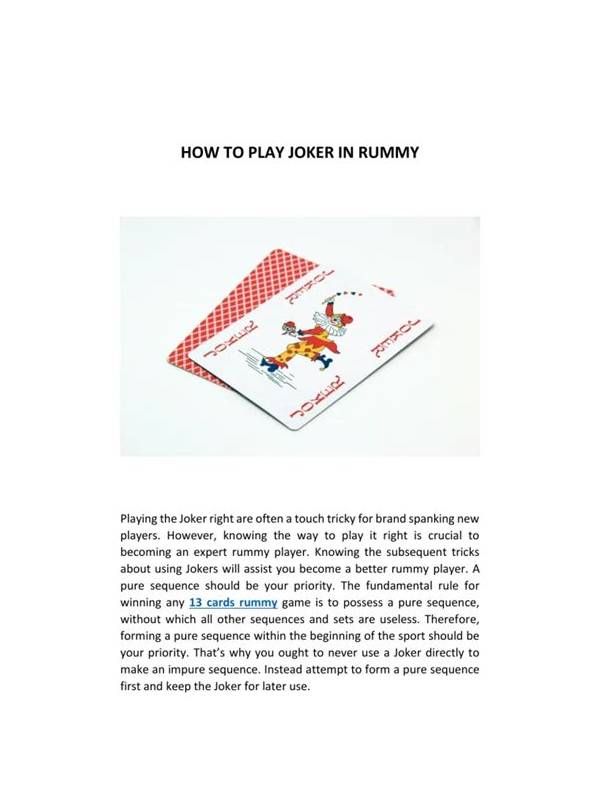
A joker can make a rummy hand more flexible, but it is not a universal rescue card. Its effect depends on the variant, the required groups, and the cards around it. Before relying on one, read the table rules for how jokers may substitute and what declarations require.
The first question is whether you have a valid natural requirement. Many Indian rummy formats require at least one pure sequence, meaning a sequence made without a joker. If your hand lacks that structure, placing the joker into another group may leave the main condition unsatisfied. A joker can reduce the number of exact cards needed, but it cannot replace a rule that specifically demands natural cards.
The second question is where the joker removes the most uncertainty. A joker beside two cards of the same suit may complete a sequence immediately, while a joker used in a scattered set may still leave several cards unresolved. Compare the number of cards that become organized, not just the visual appeal of one combination.
The third question is flexibility. Sometimes the joker is more valuable in your hand than in a group you can already complete naturally. Keep it uncommitted for a short period if multiple routes remain open. Do not keep it forever, though. If holding it prevents you from reducing high-value loose cards or meeting a sequence requirement, its theoretical flexibility may be costing more than it provides.
A common mistake is to treat the joker as permission to keep every difficult card. It is usually better to remove an isolated high card than to preserve it because a joker might connect later. Another mistake is to announce a hand without checking each group against the exact rules. Use the declaration review provided by the table, if available, and confirm that every card is assigned legally.
So, can a joker rescue an unclear hand? It can improve the hand’s possibilities, but only when it supports a valid structure and reduces genuine uncertainty. Evaluate it after every draw, check the variant’s rules, and remember that a flexible card is useful because of the surrounding hand—not because it guarantees a win. During practice, make two arrangements of the same hand: one that uses the joker immediately and one that keeps it available. Compare which arrangement leaves fewer unassigned cards and which still meets the rules. This teaches you to value the joker by function. It also shows why a flashy group can be inferior to a quieter arrangement that protects the complete hand.