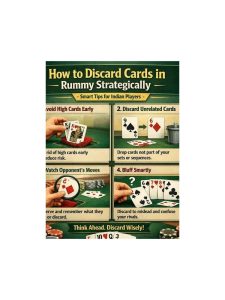
Rummy Guide: Use a Fixed Order for Hand Inspection
A hand can look different after every draw, and constant rearrangement may make it harder to see what actually changed. A fixed inspection order creates a stable reference. It is a practical routine for online or physical play and does not require calculations.
First check the groups that are already strongest. Confirm which cards belong together and whether any group depends on a joker or an unresolved connection. This step protects stable progress from being overlooked while you focus on new possibilities.
Second inspect the cards that could connect two routes. These connectors deserve attention because they may be useful in more than one arrangement. Ask whether each one still has realistic homes. A card that once connected two groups may become less useful when one group changes.
Third review loose cards by penalty exposure and recovery difficulty. Do not discard solely because a card has a high value or looks unattractive. Consider how easily it could be replaced if your plan changes. A low-point card can still be costly if it is the only bridge between two useful groups.
Fourth check the hand against the format’s structural requirements. A hand can look tidy while still missing an important type of sequence or group. The checkpoint should be factual: what is complete, what is pending, and what cannot yet be declared. Avoid treating a visual arrangement as proof of legality.
Finally select a small number of candidate discards. Compare them using the same criteria each time: hand improvement, points, information given, and repair cost. Then act. The routine should reduce uncertainty, not become a reason to delay forever.
Practice the inspection order with open-hand examples or short reviews. Consistency is more valuable than speed at first. Once the sequence becomes familiar, you can shorten it when the hand is simple and expand it when a decision carries unusual risk.
The order also helps with communication during a teaching round. You can explain that you first protected the stable structure, then compared connectors, then reviewed loose-card risk. A learner can follow the sequence without needing to memorize every possible combination. If another player points out a missed route, add it at the appropriate inspection stage rather than rebuilding the whole method. A fixed order is a framework, not a rigid prohibition against creativity; it simply gives creativity a reliable starting point.
The routine can be written on a small note during practice: groups, connectors, loose cards, requirements, candidates. Remove the note when playing a setting that does not permit aids. The aim is to internalize the order, not to depend on a permanent prompt. With time, the sequence becomes a quiet scan that is quick enough for ordinary turns and available for deeper checks when the hand is difficult.