Rummy FAQ: What Is a Good Reason to Break a Partial Sequence?
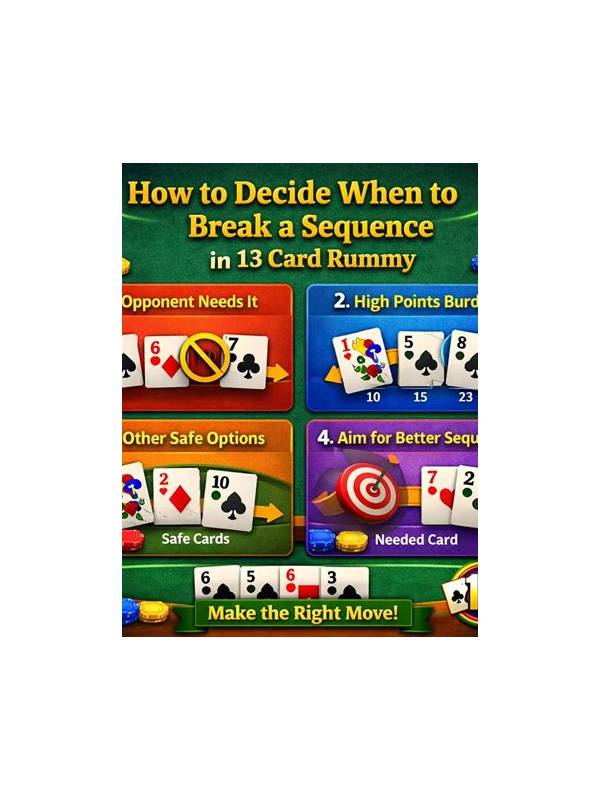
Breaking a partial sequence feels uncomfortable because it looks like giving up progress. Sometimes it is the best way to create a legal hand. A partial sequence is a proposal, not a permanent asset, and its value should be compared with the alternatives available now.
The strongest reason to break one is a legal requirement. If the partial sequence is not pure or natural when your rules require one, and another route can satisfy that condition, protect the legal route first. A visually neat group that cannot be used in a valid declaration has limited practical value.
Cost is another reason. If a partial sequence contains high-point cards and depends on one exact missing rank, its waiting cost may exceed its potential. Ask how many turns you can afford to wait and what happens if the card never arrives. A low-point partial route can sometimes remain as a small experiment, while a costly route needs better evidence.
Break the sequence when it blocks a stronger completed or nearly completed structure. Compare the number of useful draws, the penalty of failure, and the number of roles each card can play. A pair that supports a set and a sequence may be more valuable than a longer-looking chain with only one continuation.
New information can also justify the change. Repeated visible discards, a completed meld, or your own new draw may reduce the route’s realistic options. Do not treat this as proof that the original choice was foolish. It means the information set has changed and the plan should change with it.
Before breaking, check whether one card can be moved rather than dismantling the entire route. Sometimes a small rearrangement preserves one useful link. If the route must be released, discard the card with the highest penalty and lowest chance of serving another plan, while keeping the cards that retain multiple uses. Planned flexibility is different from random reshuffling. Make the decision promptly once the evidence is sufficient. Rebuilding the same partial sequence repeatedly can create the illusion of analysis while delaying a necessary discard. A short comparison of legality, waiting cost, and alternative value is enough. After the change, give the new route a fair review period instead of immediately returning to the old arrangement because the new one feels unfamiliar. After breaking the route, arrange the remaining cards again. A clean view makes the new plan easier to evaluate and prevents the old pattern from controlling the next discard.